Article

From Day Hikes to Your First Night Out on the Trail

The jump from day hiking to a first night out is smaller than it looks. Three things are worth practising on ordinary day walks first — how you pack, how you navigate off paper, and how you treat water — and only then does picking the trip become the interesting question.

beginner backpacking first overnight day hiking navigation water treatment trip planning
From Day Hikes to Your First Night Out on the Trail

The gap between a day hike and your first overnight backpacking trip looks enormous from the day-hike side of it. Mostly it is a sleeping bag, a stove and a few more litres of water; the walking is the part you already know how to do. What separates the two is not fitness or nerve so much as a handful of small competences — and every one of them is easier to build on an ordinary Saturday walk than on a Friday night twelve kilometres from the car.

Three are worth practising on purpose. How you load a pack: not only what goes in it, but where each thing rides. How to work from a paper map and a compass, for the day the phone is flat or the cloud comes down. And how you plan to treat water, decided at home rather than at a stream you have never seen.

The pages below take those three in turn, and then the question that only gets interesting once they are handled: where to go first.

This article references third-party websites for informational purposes only. PackLite does not host, own, or claim any rights over the content of the linked sites. All screenshots are used for illustrative purposes and link back to their original source.
More on this topic

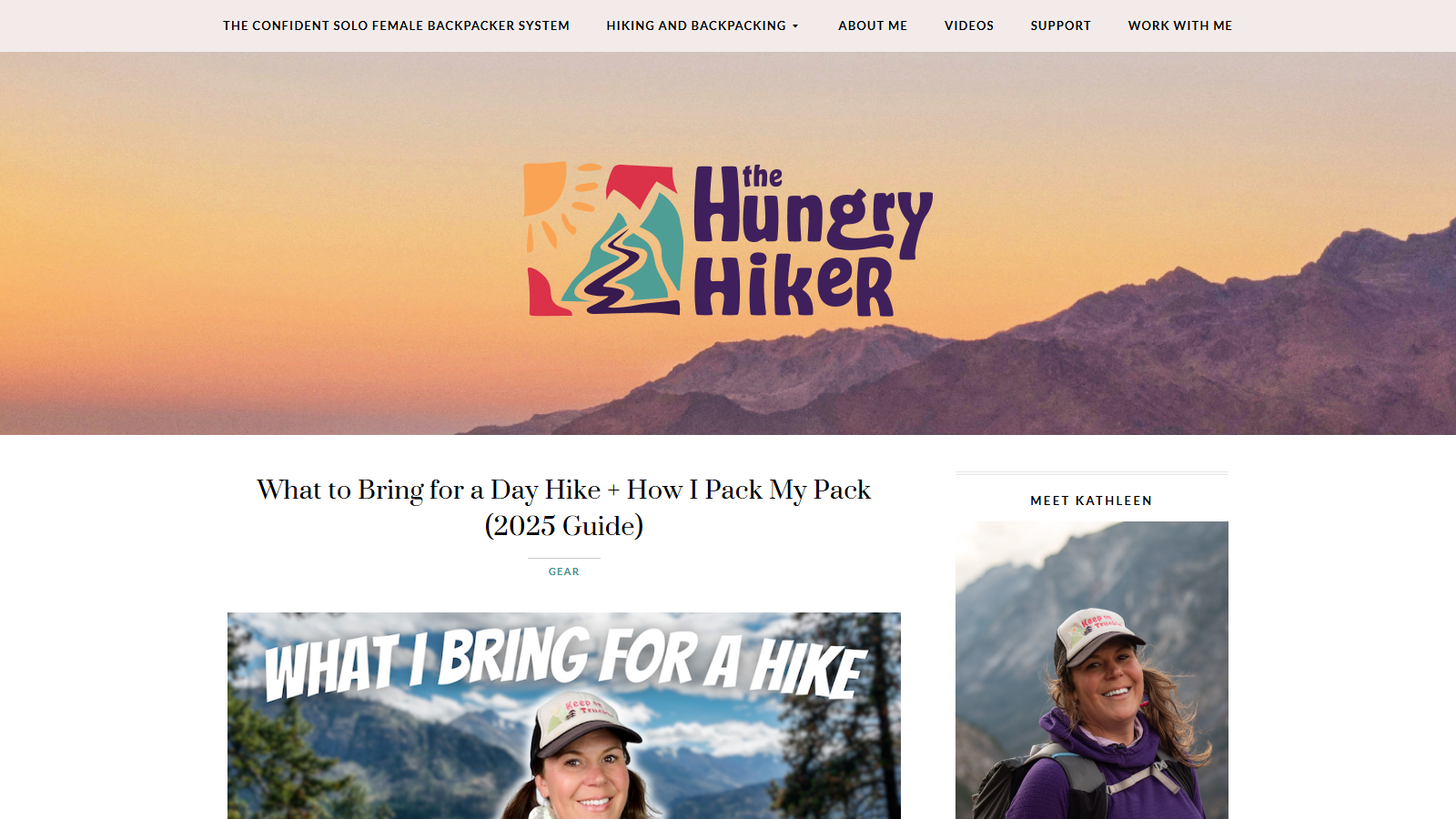
The Hungry Hiker blog header with a colorful logo over a sunset mountain ridge, above the article headline 'What to Bring for a Day Hike + How I Pack My Pack (2025 Guide)', a 'What I Bring for a Hike' featured image of the author smiling in a trucker cap, and a 'Meet Kathleen' author photo in the sidebar

Day Hike Packing List and Pack Setup from The Hungry Hiker

The Hungry Hiker is Kathleen Neves's hiking blog, and her 2025 day-hike guide earns its catalog spot by answering the question that stalls most beginners: what actually goes in the pack, and where.

Kathleen writes for people planning their first solo day hike, and the guide reads that way — reassuring and specific, built around her own kit rather than a generic checklist. She names exactly what she carries, including a Gossamer Gear Loris 25 pack, a Garmin inReach Mini 2 satellite communicator, and a Sawyer Squeeze water filter, so you're looking at real gear choices instead of vague category labels.

The "how I pack my pack" half is what sets the guide apart: she walks through where everything rides in the pack, which is the part most packing lists skip and the part you'll be glad of at the trailhead. The list tracks the classic ten essentials along the way.

One honest trade-off: the recommendations follow a single hiker's setup, so treat them as a template to adapt rather than a universal rule — Kathleen's picks reflect her own trails and seasons, and yours may differ. As a starting point for a first solo day hike, it's one of the more approachable guides you'll find.

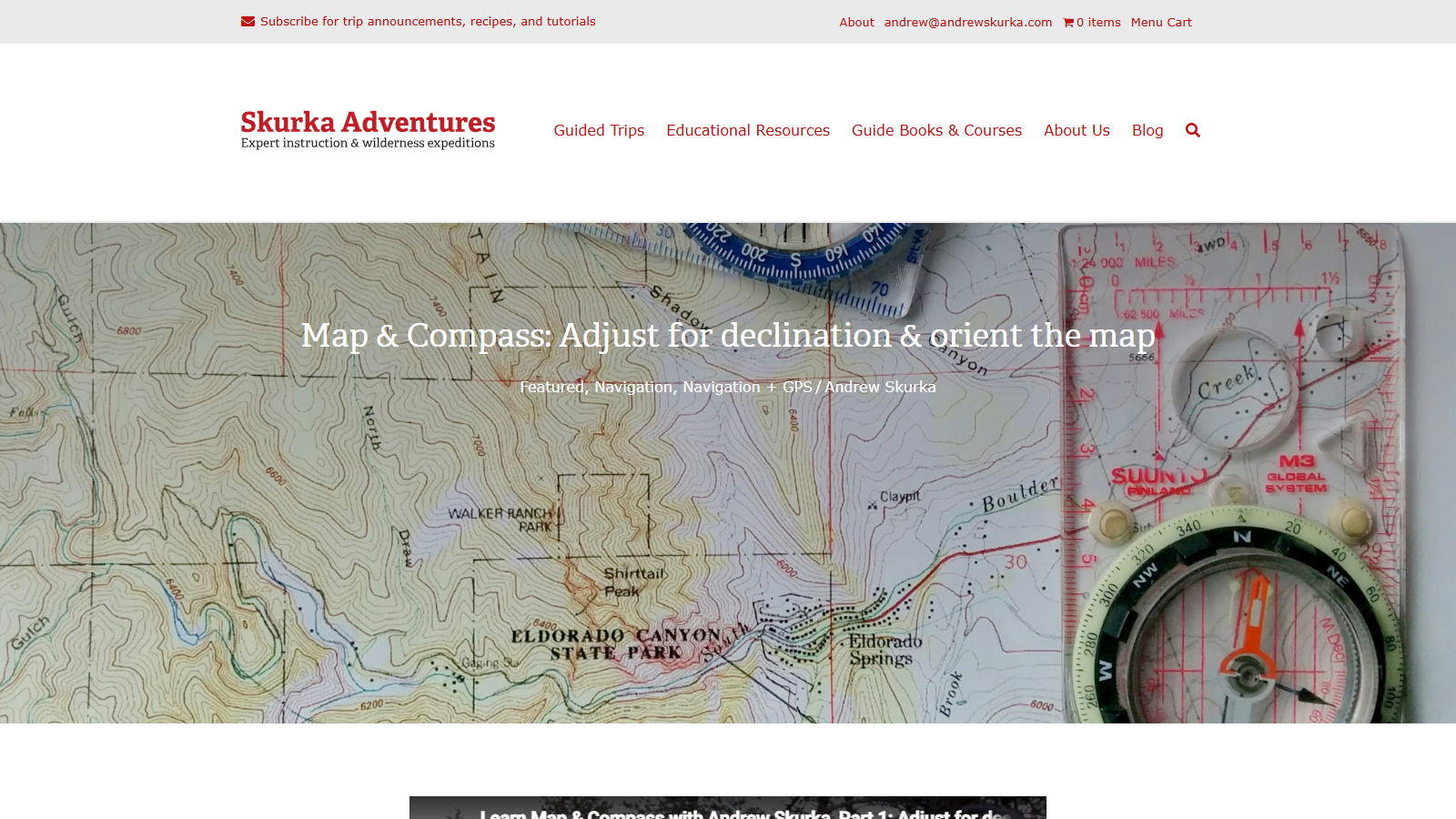
The Skurka Adventures site header in red serif type, tagline "Expert instruction & wilderness expeditions", with a navigation bar reading Guided Trips, Educational Resources, Guide Books & Courses, About Us and Blog, above a full-width photo of a USGS topographic map of Eldorado Canyon State Park with two baseplate compasses laid on it: a Suunto M3 Global with an orange magnetic needle at right and a blue-bezelled compass at top. The article headline "Map & Compass: Adjust for declination & orient the map" is overlaid in white across the map, with the byline "Featured, Navigation, Navigation + GPS / Andrew Skurka" beneath it.

Declination and Map Orientation on Skurka Adventures

Skurka Adventures is the site of long-distance hiker and guide Andrew Skurka, and this page covers the two setup steps most people skip: adjusting a compass for magnetic declination, and orienting a paper map to the ground in front of you.

The explanation starts with why declination exists and why it varies depending on where you are standing, then splits the instructions by the compass you own. If your baseplate compass has a declination adjustment — the photos show a Suunto M3 Global among the models on the table — you set it once and can then read straight off the map. If it does not, Skurka gives the arithmetic workaround you have to redo every time instead. The map-orienting section is the practical payoff: lay the compass edge or the meridian lines along a north-south grid line, turn yourself and the map together until "red is in the shed", and the paper finally matches the terrain.

It runs to roughly a thousand words, with instructional photos and short embedded video segments, so you can work through it in one sitting. The scope is narrow, though: taking and following a bearing gets only a passing mention here. And because declination values drift over the years, look up the current figure for your area rather than reusing a number printed on an older map or page.

SectionHiker article page headed '10 Best Backpacking Water Filters and Purifiers of 2026' with the subhead 'Make backcountry water sources safe to drink', bylined Philip Werner and dated April 5, 2026, above a lead photo of a sunlit conifer forest under a blue sky overlaid with the words 'Best Water Filters'

10 Best Backpacking Water Filters and Purifiers of 2026

SectionHiker is Philip Werner's independent hiking site, and this gear guide is its standing answer to a practical problem: how to make backcountry water sources safe to drink. Werner dated the current version April 5, 2026, and the page is flagged as a nine minute read.

Rather than stopping at a ranked list, the guide works through the treatment methods themselves — squeeze and hollow-fiber filters, chemical treatment, and ultraviolet purification — with practical usage guidance attached to each. That structure is what earns it catalog space. Whether you want a filter or a purifier depends on where you are hiking and what you are trying to remove, and this page covers both categories instead of assuming one answer suits every trip.

Werner keeps a separate FAQ explainer devoted to the ultraviolet method, published March 2, 2022 and tagged under the site's Frequently Asked Questions section, if you want that one approach in more depth before deciding whether a UV pen belongs in your kit.

backcountry-water-treatment-inline.png 441 KB

Two honest limits. It is a ranked roundup fixed to early 2026, so the specific models it names will age faster than the method comparison around them; read it for the categories rather than as a current shopping list. The page also carries affiliate links, which SectionHiker discloses in a line above the article.

Blog page bordered in mustard yellow, headed '18 Adventure-Worthy Backpacking Trips for Beginners' above a red, blue and yellow graphic reading 'BEGINNER BACKPACKING TRAILS' set over a rocky alpine basin; a sidebar portrait of the author holding a small dog sits under 'Meet Allison'

18 Beginner Backpacking Trips on She Dreams of Alpine

She Dreams of Alpine is backpacker and outdoor guide Allison Boyle's blog, and this list of eighteen trips earns a catalog slot for the audience it targets: people who haven't done an overnight backpacking trip yet and want a first route to build confidence on.

The roundup splits into twelve US trips and six international ones, with most falling in the two-to-five-day range -- long enough to feel like a real backpacking trip, short enough to attempt before committing to a week-plus thru-hike. Boyle frames backpacking as the gateway into bigger outdoor adventures, and the list reads as a beginner-focused shortlist rather than an exhaustive trail database.

Because it covers eighteen destinations in one post, each trip typically gets a short write-up rather than a full day-by-day itinerary -- useful for narrowing down where to go, less useful if you want mileage-by-mileage planning detail for a specific trail. Plan on following up with a dedicated guide once you've picked a destination from the list.

Worth knowing before you dig in: the same site sells a paid backpacking program and offers a free starter-kit download alongside its blog content, so the trip write-ups sit next to that business rather than on a fully separate publication.