

Type "best hiking gear" into a search engine and you'll get ten near-identical listicles, half of them stuffed with affiliate links to gear the writer has never carried past a parking lot. That's not hiking gear review sites — that's marketing dressed up as advice. The reviewers worth your time are a different breed: people who've hauled a quilt through an 18°F night on the John Muir Trail, swapped their footwear mid-thru-hike because their feet demanded it, or logged fuel consumption across a thousand kilometres just to answer one question honestly. Their verdicts come from trail miles, not sponsorship tiers.
This article rounds up seven independent gear reviewers and bloggers whose work holds up: ultralight purists, budget hackers, sleep-system nerds, footwear obsessives, and more. Each one tests gear the way you'd want a friend to — thoroughly, honestly, and without a brand deal clouding the verdict. Read on to find the voices worth following before your next gear upgrade.
The Ultralight Purist
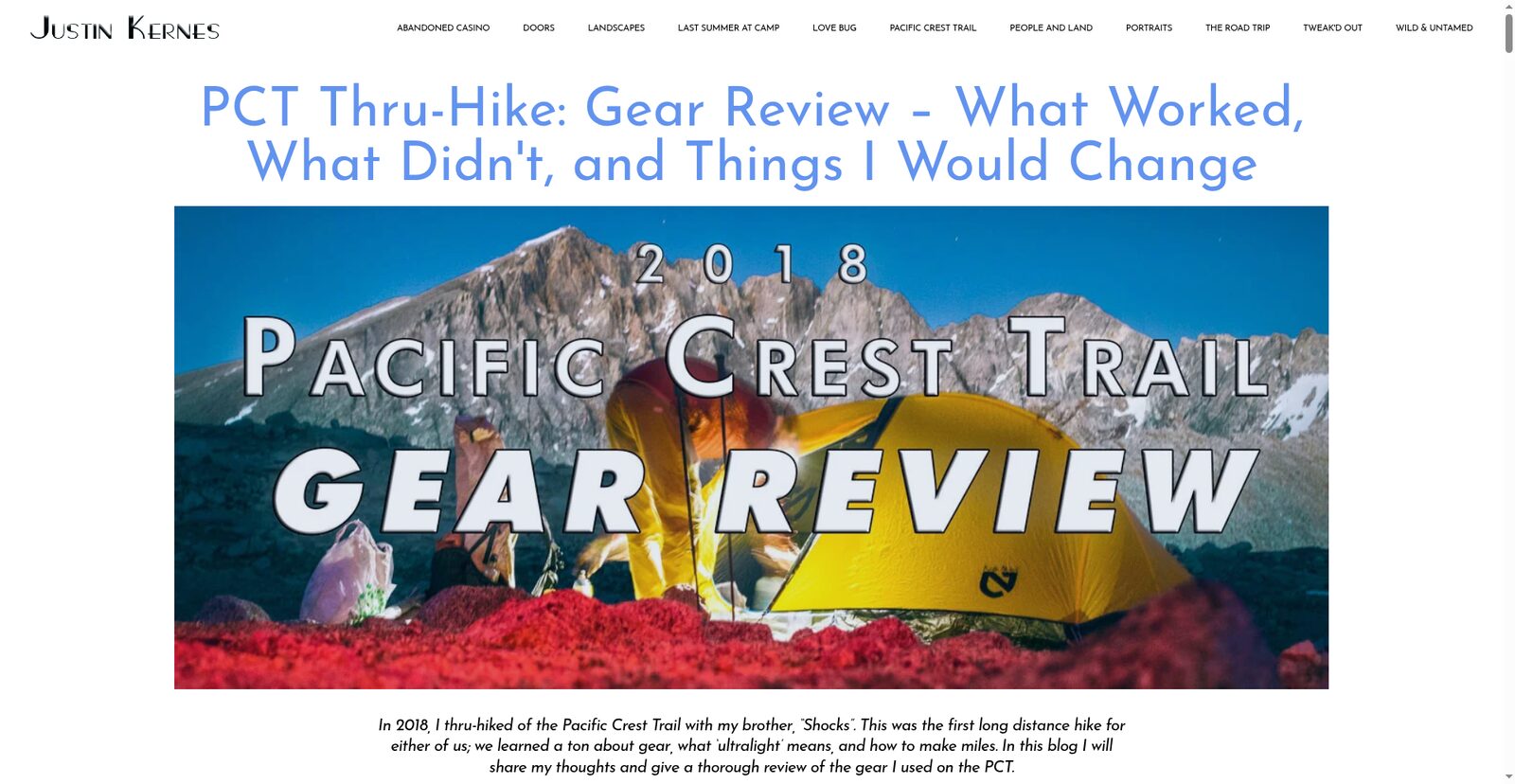
Justin Kernes hiked the Pacific Crest Trail in 2018 and did what most thru-hikers only talk about — he wrote up exactly what was in his pack, item by item, and graded it against 4,265 km of actual use.
A PCT gear review written after the fact carries a different kind of authority than a pre-trip packing list. Kernes isn't guessing what might work on a five-month thru-hike from the Mexican border to Canada — he's reporting back on what did, piece by piece, from shelter to socks. That structure is what makes his write-up genuinely useful: instead of a single blanket recommendation, he breaks the review down item-by-item, flagging what performed, what he'd swap out, and what surprised him either way.
The value here is the specificity. Generic gear guides tend to hedge — "a good tent should be lightweight and durable" tells you nothing. Kernes tells you what tent he carried, what it weathered, and whether he'd bring it again. That's the difference between advice and a data point you can actually weigh against your own trip.
For ultralight-curious hikers, this kind of after-the-fact honesty is worth more than any pre-season buyer's guide. Gear looks different at kilometre 200 than it does on a store shelf, and Kernes is one of the few writers willing to show that gap plainly — including the choices he got wrong.
If you're planning your own long-distance hike and want a base-weight sanity check from someone who's actually finished a PCT thru-hike, this is a solid place to start. Read the full item-by-item breakdown at Justin Kernes — 2018 PCT Gear Review.
Of course, not every hiker is chasing the lightest possible pack — some are chasing the cheapest one, and that's a different kind of expertise entirely.
The Budget Maximizer
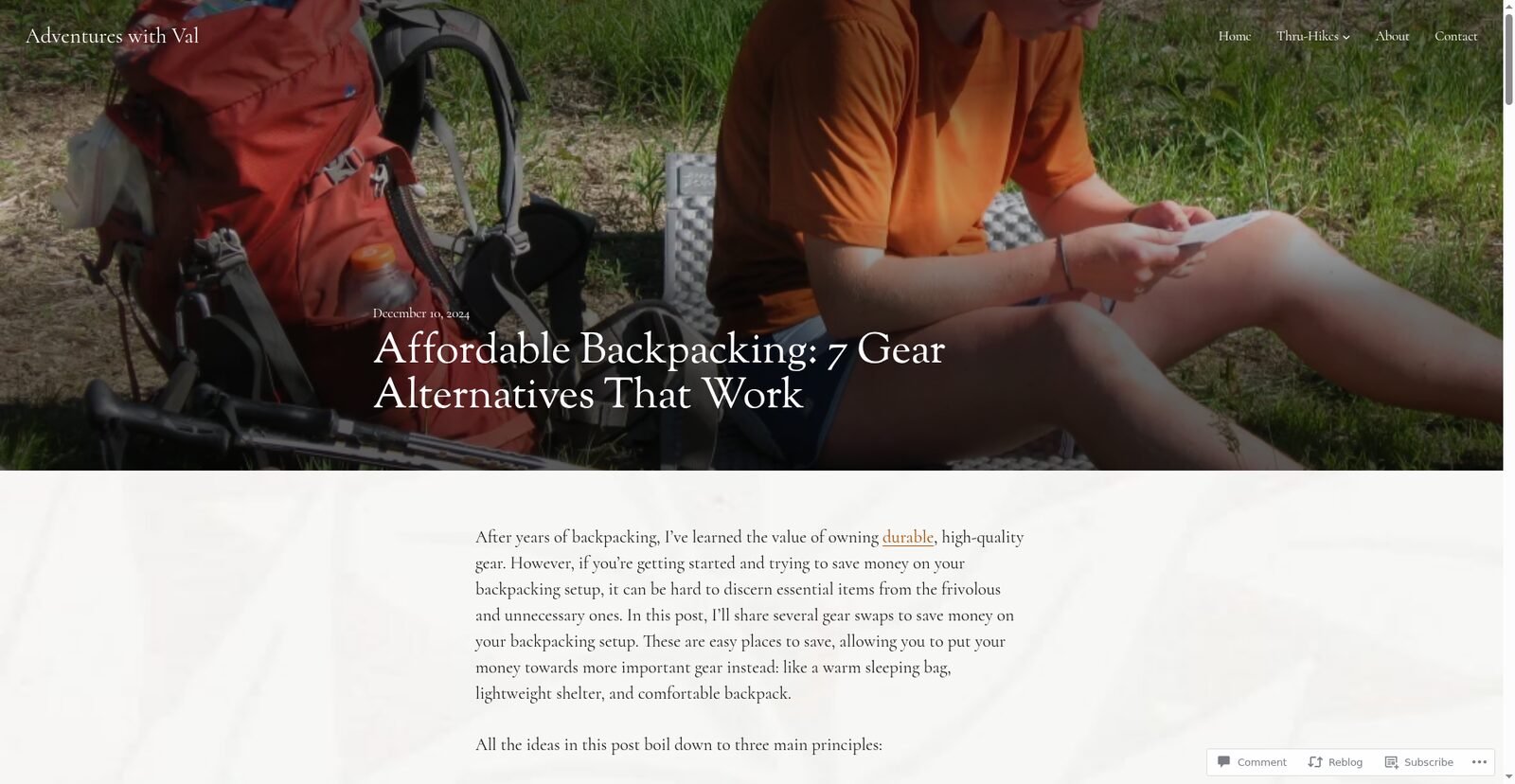
Val has walked the Appalachian Trail, Continental Divide Trail, Colorado Trail, and Pacific Crest Trail, and her gear advice reflects a hiker who has repeatedly had to choose between an expensive item and a cheaper one that does the job.
Most gear coverage assumes an unlimited budget, which is exactly backwards for a lot of hikers staring down four figures of gear costs before they've even bought a permit. Adventures with Val fills that gap directly. Her December 2024 piece on money-saving backpacking gear swaps reads less like a listicle and more like a hiker's own trail-tested substitutions — what she actually replaced, and what she got in return for the savings.
Having covered the AT, CT, PCT, and CDT, Val isn't recommending budget gear out of theory; she's recommending it because she carried the cheaper option across multiple long trails and it held up. That's a meaningfully different endorsement than "this budget item looks good in photos."
The honesty extends to trade-offs, too — a budget swap that saves weight but costs comfort, or a discount item that performs identically to its expensive counterpart, gets called out either way. That kind of nuance matters more to a beginner on a tight budget than another generic "cheap vs. expensive" chart with no trail time behind it.
For hikers trying to build a functional kit without draining their savings, this is a genuinely useful reference — proven swaps from someone who has covered thousands of trail kilometres testing them. See the full list of swaps at Adventures with Val — Money-Saving Backpacking Gear Swaps.
Budget is one axis of the gear equation — but for anyone who's shivered through a cold night with the wrong sleep system, comfort and warmth matter just as much as price.
The Shelter & Sleep-System Specialist
TrailVerdict took the quilt-versus-sleeping-bag debate out of theory and into the field, testing eight sleep systems at 18°F (-8°C) on the John Muir Trail to see which ones actually held up.
The quilt-vs-sleeping-bag argument shows up in every ultralight forum, usually settled with opinion rather than evidence. TrailVerdict's 2026 comparison takes the opposite approach: eight different sleep systems, one demanding cold-weather test on the JMT, and a direct side-by-side verdict at the end. That's a meaningfully larger sample size than most gear write-ups bother with, and testing at 18°F specifically stress-tests the systems at a temperature where warmth failures actually show up.
What makes this review useful isn't just the final ranking — it's the comparison table laying out how each system performed under identical conditions. A quilt that's perfect for a summer AT hike might fall short at altitude on the JMT in shoulder season, and this kind of controlled, side-by-side test surfaces exactly where that line sits.
Sleep systems are also one of the more expensive and hardest-to-return gear categories, which makes a field-tested comparison particularly valuable before committing to a purchase. This is where tracking your own gear choices pays off, too — a tool like PackLite lets you log which sleep system you're carrying and see how its weight stacks up against the alternatives TrailVerdict tested, before you commit to a purchase.
Whether you're a quilt convert or a sleeping-bag loyalist, this comparison is worth reading before your next cold-weather trip. Read the full comparison at TrailVerdict — Backpacking Quilt vs. Sleeping Bag Comparison 2026.
Sleep systems keep you warm at camp — but what's on your feet during the day shapes the hike just as much, if not more.

The Footwear Obsessive
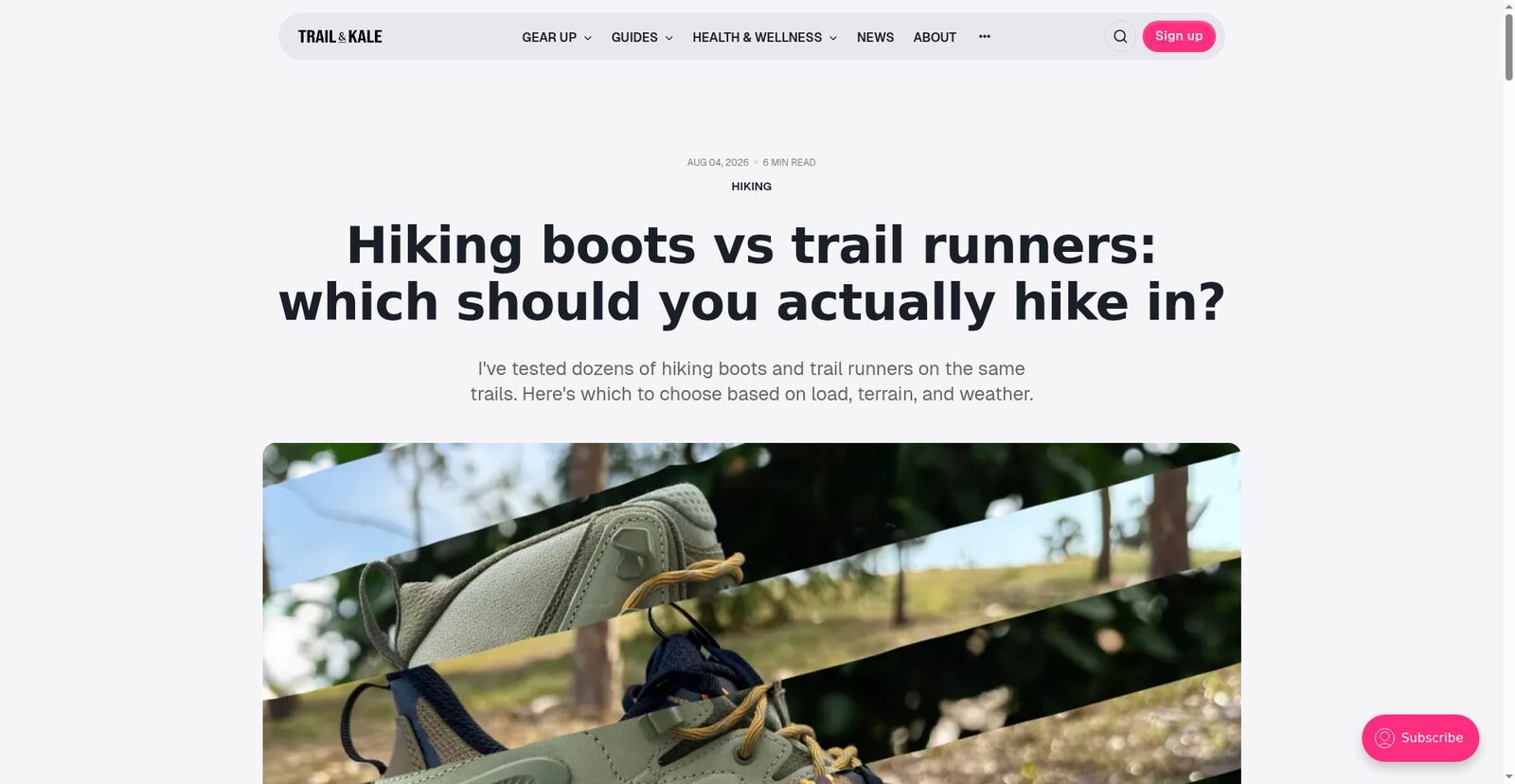
Trail & Kale tackles one of hiking's most persistent debates — boots versus trail runners — with first-person, long-distance field testing rather than a generic pros-and-cons list.
Footwear is arguably the single most personal gear decision a hiker makes, and also the one most poorly served by generic advice. "It depends on your feet" is true but useless. Trail & Kale's boots-vs-trail-runners piece goes further, working through how load, terrain, and weather each shift the calculus — a heavier pack demands more ankle support than a light one, technical scree favours a stiffer sole, and a wet shoulder-season trail changes the trade-off between a breathable trail runner and a waterproof boot.
That framework is what elevates this beyond another "boots or trail runners" coin flip. Instead of picking a winner, the review breaks the decision into the actual variables that determine which category suits a given hike, then works through the field-tested reasoning behind each one.
For hikers switching between trip types — a fastpacking weekend one month, a heavy resupply-carry the next — this kind of conditional advice is far more useful than a blanket recommendation. Footwear that's ideal for one trip can be the wrong call entirely on the next, and knowing which variables to weigh matters more than knowing which shoe "wins" in the abstract.
If you've ever stood in a gear shop paralysed between a trail runner and a boot, this comparison gives you an actual framework to work from. Read the full breakdown at Trail & Kale — Hiking Boots vs. Trail Runners.
Footwear carries you down the trail, but what's on your back determines how much that trail wears you down — which is where load-bearing pack reviews come in.
The Pack Load-Tester
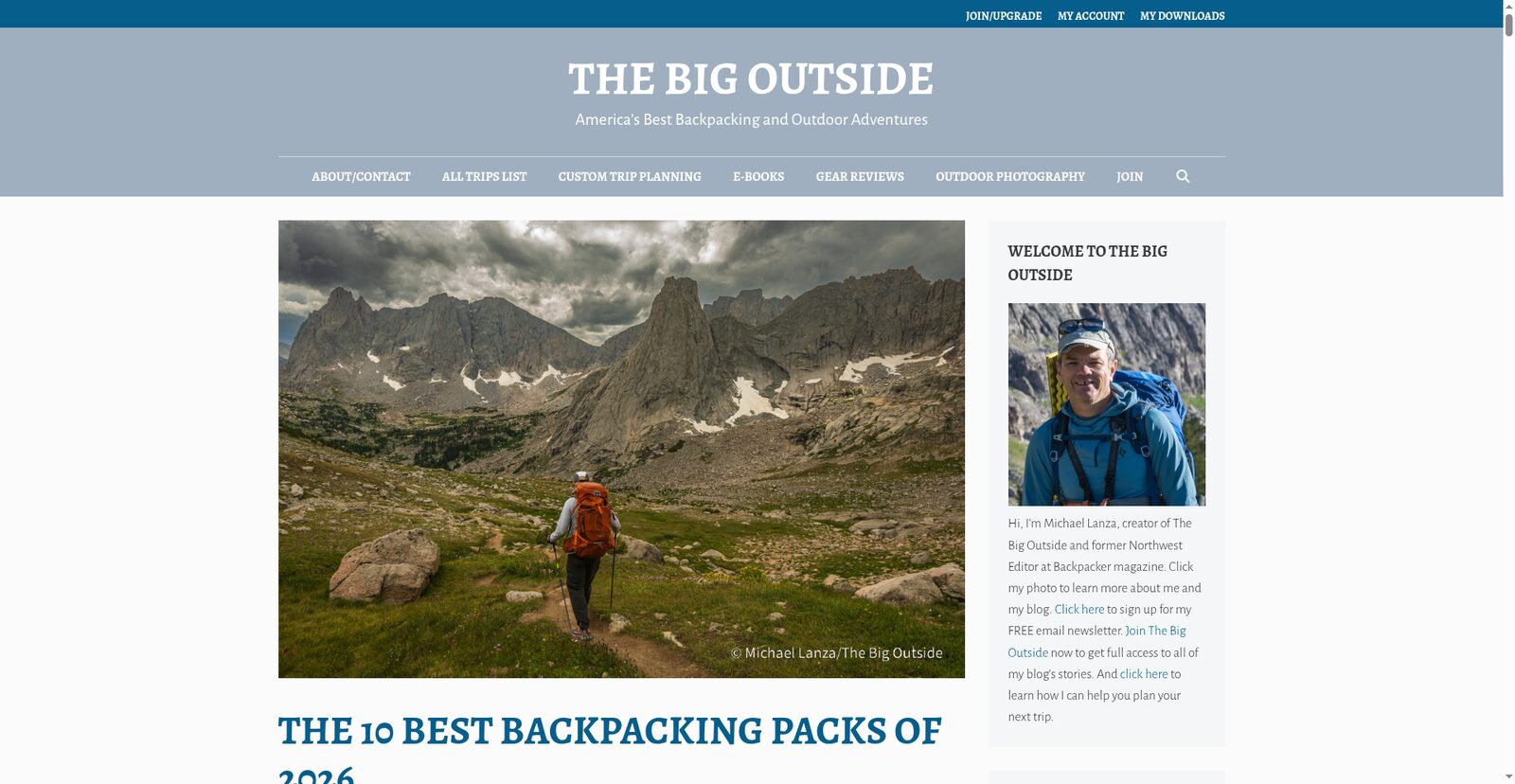
Michael Lanza, a veteran outdoor journalist at The Big Outside, tests backpacks the way most hikers wish someone would — loaded, on real terrain, across multiple days.
A backpack review done in a living room, with the pack empty and unworn, tells you almost nothing about how it will feel on day three of a resupply carry. Lanza's approach at The Big Outside is different: his roundup of the best backpacking packs comes from multi-day comparisons under real loads, on trail, where a pack's suspension, hip-belt fit, and load transfer either hold up or don't.
That distinction matters more than it sounds. A pack can feel fine at 8 kg in a shop and become genuinely uncomfortable at 15 kg on uneven, alpine terrain under storm clouds — exactly the kind of conditions his reviews are shot in and written from. Comparing multiple packs under those same real-world conditions gives the review a consistency that a single-pack write-up can't match.
As a veteran outdoor journalist, Lanza also brings a longer frame of reference than a one-off blogger — his comparisons draw on years of testing packs against each other, not just against a single trip's experience. That's useful context when you're trying to figure out whether a pack's flaws are a dealbreaker or just a minor quirk.
For anyone shopping for a pack that has to perform under a genuinely heavy, multi-day load — not just look good on a gear-shop shelf — this comparison is worth the read. See the full pack comparison at The Big Outside — The 10 Best Packs for Backpacking.
Once your pack and its load are sorted, the next question most hikers underestimate is what's cooking dinner at the end of the day.
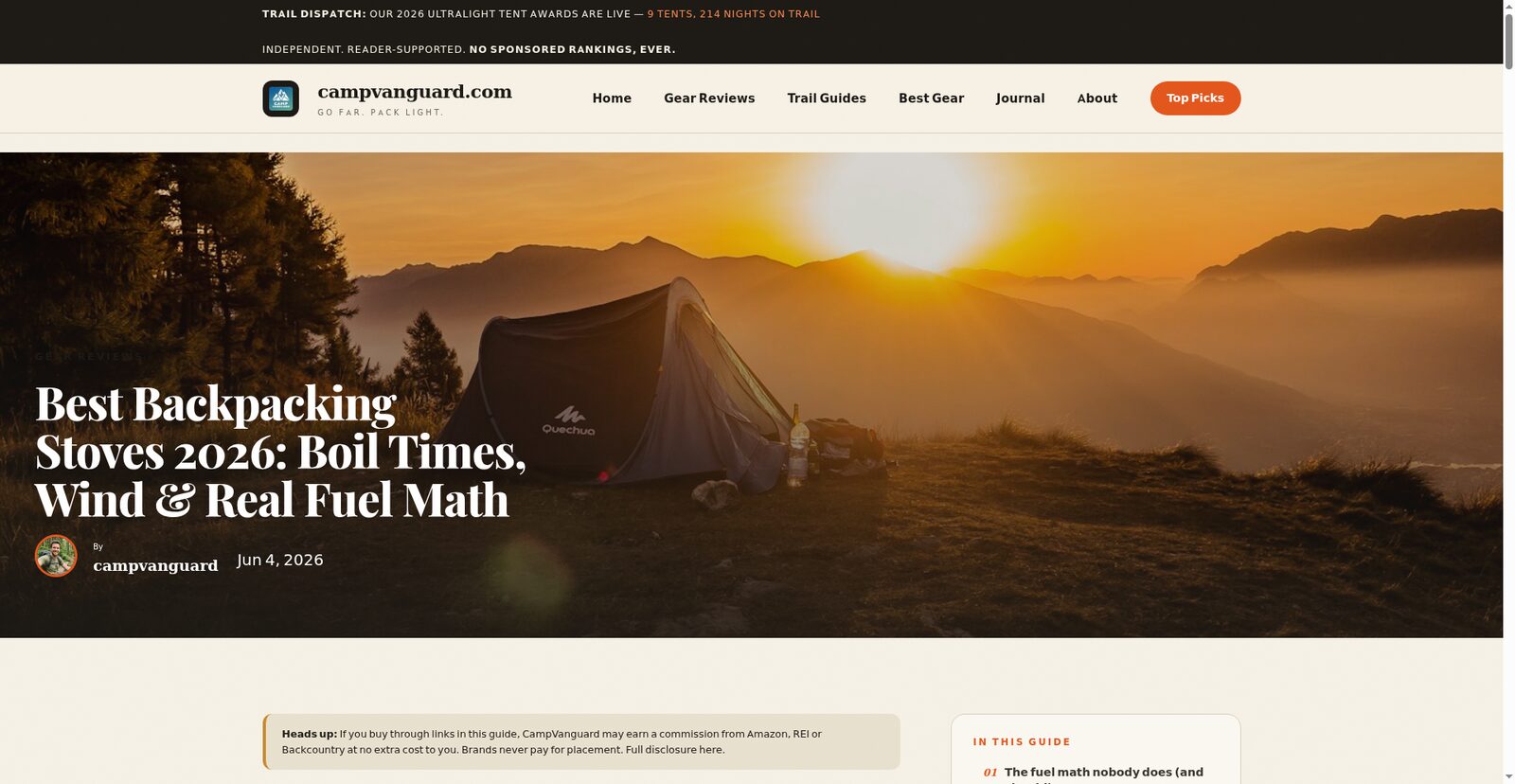
The Trail Kitchen Scientist
CampVanguard treats stove selection as an engineering problem, not a preference — comparing boil times, wind performance, and fuel economy with actual numbers behind each claim.
Stove reviews are notoriously vague — "efficient," "reliable," "great in the backcountry" — without a single measurement to back any of it up. CampVanguard's best backpacking stoves guide takes the opposite approach, running comparisons on boil times and wind performance rather than describing stoves in adjectives. That matters because stove performance genuinely varies by these exact factors: a canister stove that boils water fast in still air can lag badly in wind, while an integrated-canister system might trade raw speed for consistency.
The fuel-economy math is the part most gear guides skip entirely, and it's arguably the more important number for anyone planning a multi-day or thru-hike. A stove that boils water two minutes faster is a minor convenience; a stove that burns 20% less fuel per litre boiled adds up to real weight savings — and fewer resupply headaches — over a week-long carry.
This kind of side-by-side, numbers-first comparison is especially useful because trail kitchen gear is easy to overlook until it fails you — a stove that struggles in wind on an exposed ridge is a problem you discover at the worst possible moment, not in a controlled test.
For hikers trying to choose a stove based on how it actually performs rather than how it's marketed, this comparison is a genuinely practical reference. Read the full stove comparison at CampVanguard — Best Backpacking Stoves.
Stoves are one example of gear doing a single job well — but some of the most seasoned hikers build their entire kit around gear that does two jobs at once.
The Multi-Use Minimalist
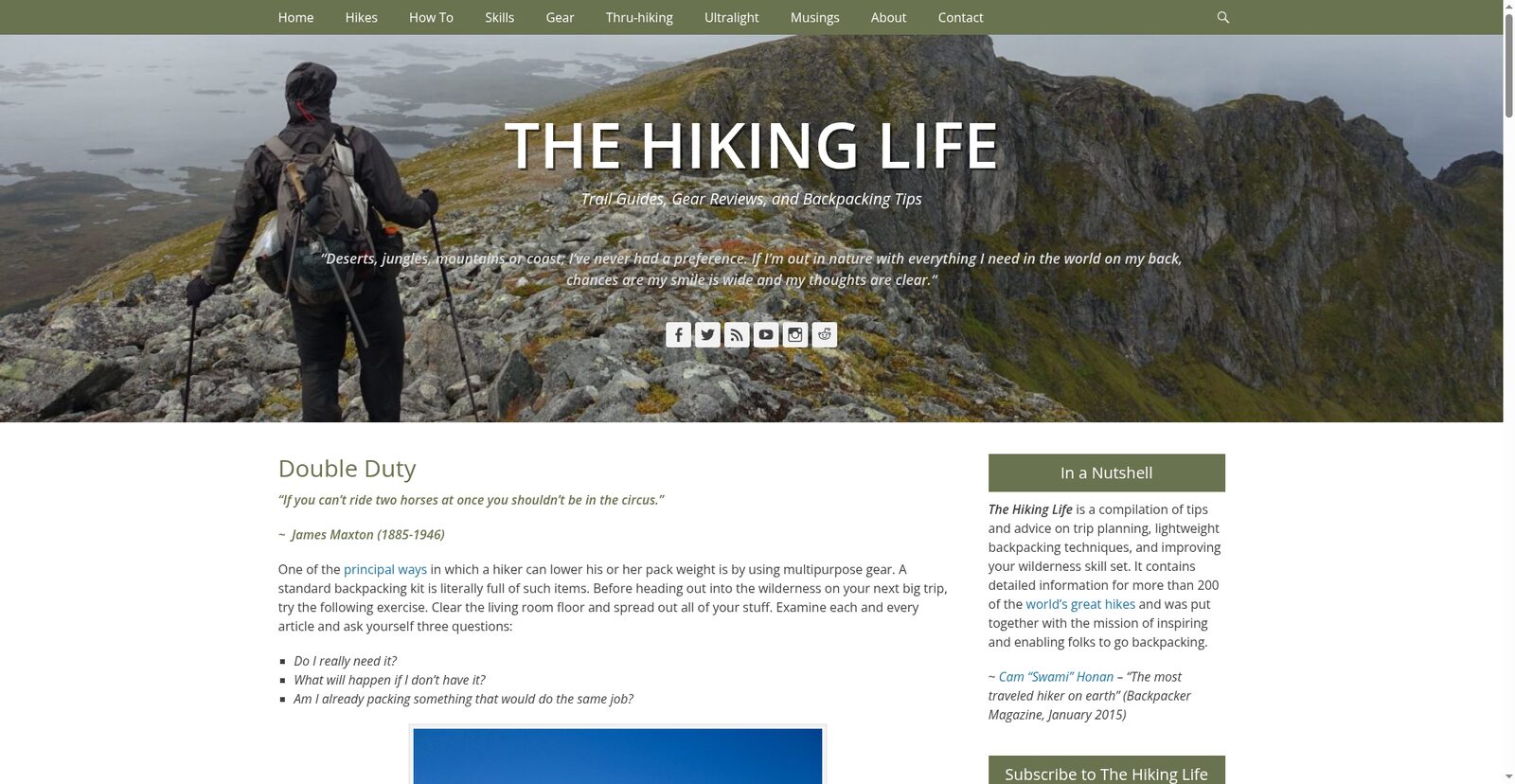
Cam Honan, one of the most widely travelled long-distance hikers writing today, lays out a philosophy of dual-purpose gear in his essay "Double Duty" at The Hiking Life.
Most gear advice focuses on choosing the best single item for a single job. Honan's "Double Duty" essay asks a different question: which items can do two jobs at once, and how much weight does that save across an entire kit? It's less a product review and more a philosophy piece — but one grounded in the kind of extensive long-distance hiking experience that makes the reasoning worth taking seriously.
The dual-purpose approach shows up in familiar examples once you start looking for it — trekking poles that double as tent supports, a puffy jacket that serves as a pillow, a pack liner that also works as a rain layer. Individually, each swap saves modest weight. Across a full kit, though, the cumulative effect is exactly the kind of base-weight reduction that separates a merely light pack from a genuinely minimalist one.
What makes this essay stand apart from typical ultralight content is that it's argued as a mindset rather than a shopping list — a way of evaluating every item in your pack by asking what else it could do, rather than simply how light it is. That framework holds up regardless of which specific products you're carrying, which is why it's aged well since publication.
For hikers looking to cut weight without simply buying lighter (and often pricier) versions of everything, this philosophy offers a genuinely different lever to pull. Read the full essay at The Hiking Life — Double Duty.
Taken together, these seven reviewers show what independent, field-tested gear advice actually looks like — and that's exactly the standard worth holding your own gear choices to.
What ties these seven reviewers together isn't a shared opinion on any single piece of gear — it's a shared method: test it on trail, report the trade-offs honestly, and let the miles do the convincing. That's a better filter for gear decisions than any sponsored "top 10" list will ever be.
Once you've read their verdicts, the next step is checking how those choices fit your own kit. Log your gear in PackLite and compare it against the reviewers' recommendations — track weight, cost, and durability as you upgrade, and see your base weight shift in real time as you swap items. It's free.
This article references third-party websites for informational purposes only. PackLite does not host, own, or claim any rights over the content of the linked sites. All screenshots are used for illustrative purposes and link back to their original source. PackLite respects the privacy policies of all referenced sites.